by Hollywood Sports
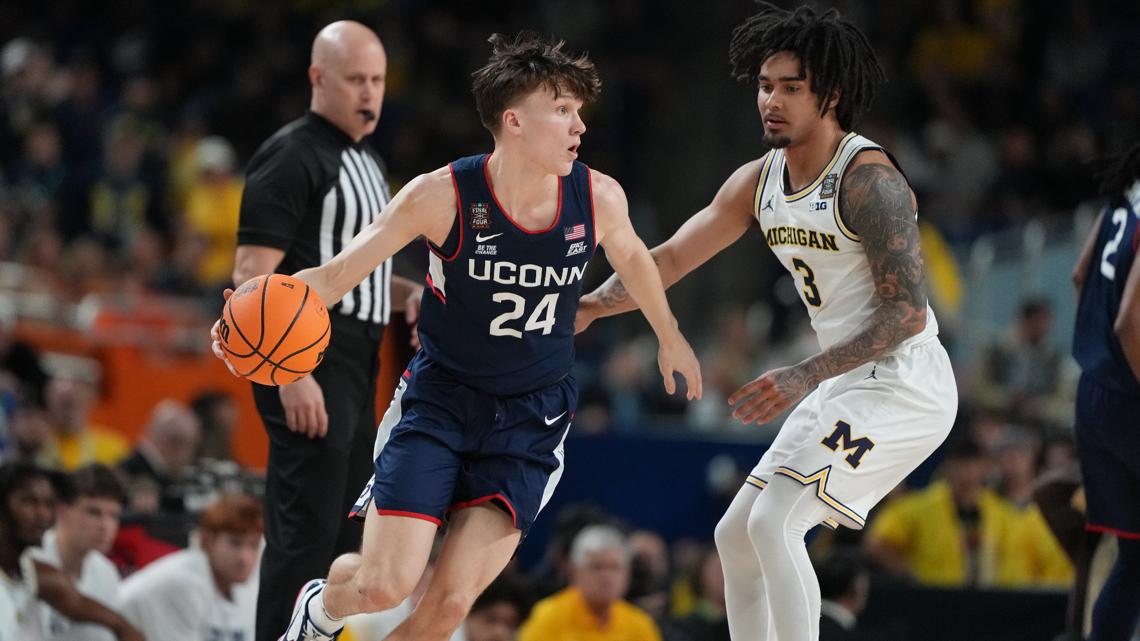
Friday, Apr 24, 2026In handicapping the national championship game between Connecticut and Michigan, the one thing I was most confident about was that the Huskies were going to bring a strong defensive effort with them in that game.
Illinois entered the Final Four with the best Adjusted Offensive Efficiency in the history of Ken Pomeroy’s database, going back to 1999 when he began his advanced analytics breakdowns of games and teams in college basketball. But UConn completely frustrated them by holding them to 33.9% shooting and a 23.1% mark from behind the arc in their 71-62 upset win against them as a 1.5-point underdog. The Huskies ranked eighth in the nation in Adjusted Defensive Efficiency — and they ranked in the top 20 in both 3-point defense and shooting inside the arc. Against the top 50 teams in Adjusted Net Efficiency, head coach Dan Hurley’s team rose to fifth in the nation in Adjusted Defensive Efficiency.
I was surprised that Arizona tried to run up and down the court with Michigan in that Final Four showdown that the Wolverines won by a 91-73 score. Hurley was not going to play those reindeer games. Here is what Hurley said on his style of play for tonight’s game: “These are all one game, Game 7, single game elimination. There have been plenty of times in the history of this tournament where the best team hasn't won it. You've just got to be better for one night, and obviously, for us, we need to play the game a certain type of way where we obviously can't get into a certain type of game with Michigan. They're an incredibly dominant team, incredibly well-coached, talent up and down the roster, physically imposing, all those things.” Translation: Hurley was going to do everything he could to make it a rock fight.
The Huskies already fit the profile of the slow killer. They played at a very slow pace by averaging 19.2 seconds per possession, the 16th longest in the nation. Their games averaged 64.7 adjusted possessions per game, the 47th lowest. The Wolverines were 12-0 this season with an average winning margin of 30.0 Points-Per-Game (not a typo, that is +30.0 PPG) when amping up the possessions to at least 75. Generally, in these battles of styles of play, the coaches who want to slow things down can impose their will. Extend the shot clock when possessing the basketball. Get back quickly on defense — and UConn excels in transition defense. Extend possessions by pounding the offensive glass — the Huskies rank 37th in the nation by pulling down 35.4% of their missed shots. Sacrifice transition scoring opportunities with extra attention in protecting the defensive glass — UConn ranked 90th by limiting their opponents to pulling down 28.7% of their missed shots. Teams that want to go fast can become frustrated if they find themselves in a slog — and it becomes a self-fulfilling prophecy.
The Wolverines demonstrated that they could get slowed down. In Michigan’s last two losses against Duke and then Purdue in the Big Ten Championship Game, there were 63 and 62 possessions. In the Big Ten tournament quarterfinals, there were only 67 possessions in the Wolverines’ 71-67 victory against Ohio State. Then, in the semifinals against Wisconsin, there were 68 possessions in Michigan’s 68-65 win. In the Huskies' last eight games since the beginning of the Big East tournament, only one of their games had more than 64 possessions — and that was their Round of 64 game against Furman, when there were 65 possessions. If Hurley can keep this streak going, I was not sure if he wins the game, but I felt very good about cashing our under tickets.
UConn had played 17 of their 26 games Under the Total with Hurley as their head coach when on the road for the second time in three days. The Huskies had covered the point spread in four straight games — and they had played 6 of their last 7 games Under the Total after covering the point spread in three or more games in a row. And while they had also covered the point spread in six of their last eight games, UConn has then played 27 of their last 34 games on a neutral court Under the Total after covering the point spread in six or seven of their last eight games.
Michigan held Arizona to 36.6% shooting, which was actually the worst defensive effort in their last three games. The Wolverines led the nation in Adjusted Defensive Efficiency — and they maintained that ranking when playing away from home. In their 13 games played on a neutral court, they are surrendering -2.5 fewer points per 100 adjusted possessions. They ranked 21st by limiting their opponents to just a 30.5% mark from behind the arc. They also ranked second in the nation by holding their opponents to a 44.1% shooting percentage inside the arc. Led by the 7’3 Aday Mara, Michigan ranked third in the nation by blocking 16.4% of their opponents' shots (Clark Kellogg was correct in labeling him as the team’s “cheat code”).
I expected a close game between these teams. But if the national championship game was going to be a blowout, it would be because UConn struggles to score. They ranked 22nd in Adjusted Offensive Efficiency, which was very good but not elite — and they fell to 43rd in those rankings in their last ten games. Silas DeMary had not been the same since getting injured in the Big East tournament. Since his return in the Round of 32, he had only scored 22 combined points in the last four games. The left foot injury to Solo Ball in their Final Four game was another concern — he was in a walking boot the next day. If he was limited, then Hurley was trading offense for defense by using Jayden Ross in his absence.
But the elephant in the room was the injuries to Yaxel Lendeborg. After playing through a lower ankle sprain in the Big Ten tournament, he re-aggravated it in their Final Four game on a drive to the lane that also triggered an MCL sprain in his knee. He relied on adrenaline to play through it in the second half — but even head coach Dusty May described his gimpy play as “like a 38-year-old man at the YMCA”. Lendeborg was going to take the court, but May had conceded he would be “limited.” Even with modern medicine, those were both injuries that needed longer than 48 hours to recover. Michigan had already been playing without L.J. Cason, who was emerging as one of their most reliable secondary scorers. If and when it becomes a half-court game, who would the Wolverines’ primary scorer be? After Lendeborg, the Wolverines had a nice cast of scorers by committee — but who steps up often changes. There was no obvious primary scorer if Lendeborg cannot continue to fill those responsibilities. That could become a problem.
On the road, Michigan’s shooting inside the arc dropped by -9.4%, the 14th biggest decline in the nation. The Wolverines had played 8 of their last 10 road games Under the Total when playing for the second time in eight days. And while the Huskies are outscoring their opponents by +11.8 Points-Per-Game, Michigan had played 28 of their 49 games Under the Total against teams that were outscoring their opponents by +8.0 or more PPG since May became their head coach.
UConn had played 6 of their last 8 games Under the Total against teams that were winning 80% or more of their games. The Huskies had also played 14 of their 21 games Under the Total in the Big Dance with Hurley — and they had played 3 of their 4 tournament championship games Under the Total when Hurley is patrolling the sidelines.
These were the reasons that the national championship was our College Basketball Total of the Year on the Under, with the number in the 144.5 range. Soon after tip-off, it became clear that the biggest threat to losing the Under would be if the game went into overtime. Michigan went into the locker room at halftime with a 33-29 lead. There was more scoring in the second half, yet the Wolverines’ 69-63 victory was a comfortable outcome for the Under. Hurley got the slower tempo he wanted as both teams only had 65 possessions in the game.
Best of luck — Frank.
Illinois entered the Final Four with the best Adjusted Offensive Efficiency in the history of Ken Pomeroy’s database, going back to 1999 when he began his advanced analytics breakdowns of games and teams in college basketball. But UConn completely frustrated them by holding them to 33.9% shooting and a 23.1% mark from behind the arc in their 71-62 upset win against them as a 1.5-point underdog. The Huskies ranked eighth in the nation in Adjusted Defensive Efficiency — and they ranked in the top 20 in both 3-point defense and shooting inside the arc. Against the top 50 teams in Adjusted Net Efficiency, head coach Dan Hurley’s team rose to fifth in the nation in Adjusted Defensive Efficiency.
I was surprised that Arizona tried to run up and down the court with Michigan in that Final Four showdown that the Wolverines won by a 91-73 score. Hurley was not going to play those reindeer games. Here is what Hurley said on his style of play for tonight’s game: “These are all one game, Game 7, single game elimination. There have been plenty of times in the history of this tournament where the best team hasn't won it. You've just got to be better for one night, and obviously, for us, we need to play the game a certain type of way where we obviously can't get into a certain type of game with Michigan. They're an incredibly dominant team, incredibly well-coached, talent up and down the roster, physically imposing, all those things.” Translation: Hurley was going to do everything he could to make it a rock fight.
The Huskies already fit the profile of the slow killer. They played at a very slow pace by averaging 19.2 seconds per possession, the 16th longest in the nation. Their games averaged 64.7 adjusted possessions per game, the 47th lowest. The Wolverines were 12-0 this season with an average winning margin of 30.0 Points-Per-Game (not a typo, that is +30.0 PPG) when amping up the possessions to at least 75. Generally, in these battles of styles of play, the coaches who want to slow things down can impose their will. Extend the shot clock when possessing the basketball. Get back quickly on defense — and UConn excels in transition defense. Extend possessions by pounding the offensive glass — the Huskies rank 37th in the nation by pulling down 35.4% of their missed shots. Sacrifice transition scoring opportunities with extra attention in protecting the defensive glass — UConn ranked 90th by limiting their opponents to pulling down 28.7% of their missed shots. Teams that want to go fast can become frustrated if they find themselves in a slog — and it becomes a self-fulfilling prophecy.
The Wolverines demonstrated that they could get slowed down. In Michigan’s last two losses against Duke and then Purdue in the Big Ten Championship Game, there were 63 and 62 possessions. In the Big Ten tournament quarterfinals, there were only 67 possessions in the Wolverines’ 71-67 victory against Ohio State. Then, in the semifinals against Wisconsin, there were 68 possessions in Michigan’s 68-65 win. In the Huskies' last eight games since the beginning of the Big East tournament, only one of their games had more than 64 possessions — and that was their Round of 64 game against Furman, when there were 65 possessions. If Hurley can keep this streak going, I was not sure if he wins the game, but I felt very good about cashing our under tickets.
UConn had played 17 of their 26 games Under the Total with Hurley as their head coach when on the road for the second time in three days. The Huskies had covered the point spread in four straight games — and they had played 6 of their last 7 games Under the Total after covering the point spread in three or more games in a row. And while they had also covered the point spread in six of their last eight games, UConn has then played 27 of their last 34 games on a neutral court Under the Total after covering the point spread in six or seven of their last eight games.
Michigan held Arizona to 36.6% shooting, which was actually the worst defensive effort in their last three games. The Wolverines led the nation in Adjusted Defensive Efficiency — and they maintained that ranking when playing away from home. In their 13 games played on a neutral court, they are surrendering -2.5 fewer points per 100 adjusted possessions. They ranked 21st by limiting their opponents to just a 30.5% mark from behind the arc. They also ranked second in the nation by holding their opponents to a 44.1% shooting percentage inside the arc. Led by the 7’3 Aday Mara, Michigan ranked third in the nation by blocking 16.4% of their opponents' shots (Clark Kellogg was correct in labeling him as the team’s “cheat code”).
I expected a close game between these teams. But if the national championship game was going to be a blowout, it would be because UConn struggles to score. They ranked 22nd in Adjusted Offensive Efficiency, which was very good but not elite — and they fell to 43rd in those rankings in their last ten games. Silas DeMary had not been the same since getting injured in the Big East tournament. Since his return in the Round of 32, he had only scored 22 combined points in the last four games. The left foot injury to Solo Ball in their Final Four game was another concern — he was in a walking boot the next day. If he was limited, then Hurley was trading offense for defense by using Jayden Ross in his absence.
But the elephant in the room was the injuries to Yaxel Lendeborg. After playing through a lower ankle sprain in the Big Ten tournament, he re-aggravated it in their Final Four game on a drive to the lane that also triggered an MCL sprain in his knee. He relied on adrenaline to play through it in the second half — but even head coach Dusty May described his gimpy play as “like a 38-year-old man at the YMCA”. Lendeborg was going to take the court, but May had conceded he would be “limited.” Even with modern medicine, those were both injuries that needed longer than 48 hours to recover. Michigan had already been playing without L.J. Cason, who was emerging as one of their most reliable secondary scorers. If and when it becomes a half-court game, who would the Wolverines’ primary scorer be? After Lendeborg, the Wolverines had a nice cast of scorers by committee — but who steps up often changes. There was no obvious primary scorer if Lendeborg cannot continue to fill those responsibilities. That could become a problem.
On the road, Michigan’s shooting inside the arc dropped by -9.4%, the 14th biggest decline in the nation. The Wolverines had played 8 of their last 10 road games Under the Total when playing for the second time in eight days. And while the Huskies are outscoring their opponents by +11.8 Points-Per-Game, Michigan had played 28 of their 49 games Under the Total against teams that were outscoring their opponents by +8.0 or more PPG since May became their head coach.
UConn had played 6 of their last 8 games Under the Total against teams that were winning 80% or more of their games. The Huskies had also played 14 of their 21 games Under the Total in the Big Dance with Hurley — and they had played 3 of their 4 tournament championship games Under the Total when Hurley is patrolling the sidelines.
These were the reasons that the national championship was our College Basketball Total of the Year on the Under, with the number in the 144.5 range. Soon after tip-off, it became clear that the biggest threat to losing the Under would be if the game went into overtime. Michigan went into the locker room at halftime with a 33-29 lead. There was more scoring in the second half, yet the Wolverines’ 69-63 victory was a comfortable outcome for the Under. Hurley got the slower tempo he wanted as both teams only had 65 possessions in the game.
Best of luck — Frank.
