by Vegas Writer
Tuesday, Oct 27, 2026Seven weeks into the NFL season, the most revealing developments involve the conditions under which teams succeed—and what happens when opponents take those conditions away.
Seattle dismantled Kansas City’s previously productive offense. Atlanta punished San Francisco’s mistakes. Chicago kept building a more dangerous passing game, while the Giants showed that a quarterback change works better when the running game provides meaningful support.
Dallas closed the week Monday with another example of that balance, defeating Philadelphia behind its strongest rushing performance of the season. Elsewhere, Cincinnati’s extraordinary second half exposed a recurring Baltimore weakness, and the Raiders’ latest defeat revealed problems extending beyond their inability to finish close games.
These are five observations from Week 7, played Oct. 22-26. Each examines a performance in the context of an emerging pattern, separating what one result establishes from what still requires proof as the season approaches its midpoint.
1. Seattle and Atlanta exposed different vulnerabilities in the unbeaten teams
Kansas City and San Francisco suffered their first losses Sunday, but the explanations were substantially different.
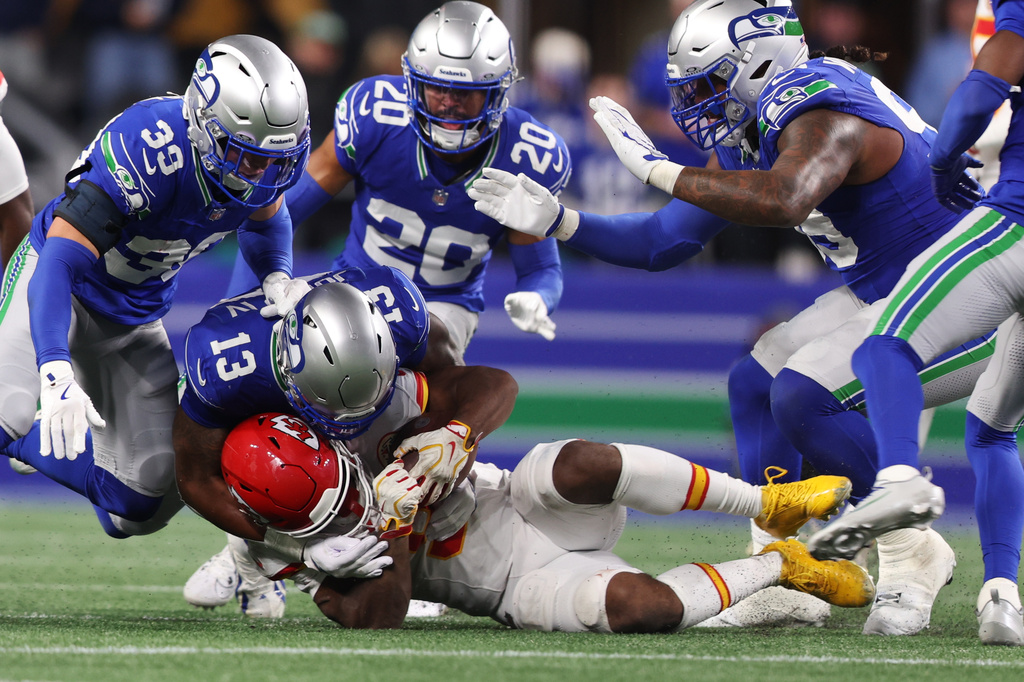
Seattle’s 20-3 win over the Chiefs systematically disrupted an established offensive identity. Kansas City entered averaging a league-leading 414 yards and 28 points per game. The Seahawks held the Chiefs to 213 yards, 11 first downs and no red-zone possessions—the first time a Patrick Mahomes-led offense had failed to reach that area in 153 starts, including postseason games.
Kenneth Walker III managed 36 rushing yards after entering as the NFL’s leading rusher. Losing that production forced Kansas City to find another answer, and its passing game couldn't compensate.
Atlanta’s 29-20 victory over San Francisco followed a different formula. The Falcons were outgained 400-295 but won the turnover battle 4-0. San Francisco limited Atlanta to 82 rushing yards on 29 attempts, showing its defense did its job.
The distinction matters as we look ahead.
Kansas City must examine how Seattle prevented its preferred offensive approaches from functioning. San Francisco must address possessions surrendered despite enough productive football to remain competitive.
Neither defeat invalidates the victories preceding it. Both identify a pressure point future opponents will study: Kansas City’s response when its running game stalls, and San Francisco’s ability to keep mistakes from erasing its offensive production.
2. Chicago’s passing game is developing beyond isolated quarterback highlights
Chicago’s 30-24 win over New England Thursday showed an offense becoming harder to defend over an entire game.
Caleb Williams completed eight passes gaining at least 20 yards. Luther Burden III accounted for four of those plays, finishing with 130 yards on four catches, all before halftime. Rome Odunze supplied three 21-yard receptions, while Colston Loveland added another explosive gain.
That distribution matters. A defense cannot solve Chicago’s passing game by focusing on one receiver or one type of route.
The Bears also connected their explosive production with scoring efficiency. Four consecutive possessions from the first to the third quarter reached New England’s red zone, producing three touchdowns and a field goal. D’Andre Swift’s rushing touchdown was his seventh through Chicago’s first seven games.
The result moved the Bears to 5-2, but their growing ability to retain control was just as significant. Chicago hasn't trailed in its last two games against Atlanta and New England. Odunze’s late third-and-9 reception helped preserve possession before Cairo Santos delivered a career-long 58-yard field goal.
Chicago still had to withstand a competitive finish. That prevents Thursday from becoming evidence of complete dominance.
It does establish a broader offensive foundation: multiple receivers generating substantial gains, a productive scoring back, and enough late execution to protect an advantage. Williams’ development becomes more consequential when those pieces function together.
3. The Giants and Cowboys showed how rushing support changes a quarterback’s assignment
The Giants introduced their third starting quarterback of the season Sunday. Dallas relied on its established veteran Monday. Both benefited from offenses that could advance the ball without repeatedly forcing difficult throws.
J.J. McCarthy completed 20 of 28 passes for 252 yards in New York’s 27-21 overtime victory over Houston. Five completions gained at least 20 yards, giving the Giants downfield production alongside their improved running game.
Cam Skattebo rushed for 124 yards on 17 carries, and Devin Singletary finished the game with a 30-yard touchdown run. The Giants produced four rushing touchdowns after totaling only two through their first six games. McCarthy could contribute meaningfully without carrying every scoring possession himself.
Dallas provided a similar lesson in its 38-21 victory over Philadelphia. Javonte Williams rushed for a career-high 155 yards, helping the Cowboys generate a season-best 204 rushing yards. Dak Prescott threw three touchdown passes, and Dallas committed no turnovers.
The implication extends beyond the familiar instruction to establish the run. Effective rushing creates more ways to finish possessions and prevents every serious situation from becoming a test of the quarterback’s arm.
Neither performance guarantees the same production against stronger resistance. Both demonstrated a useful balance.
For New York, that balance gives a newly installed starter room to develop. For Dallas, it offers a practical way to reduce the burden on Prescott while preserving the threat of its accomplished receivers.
4. Baltimore’s second-half failures have become a pattern requiring immediate correction
Baltimore’s 35-13 loss to Cincinnati was more concerning than a typical blown lead because it reinforced a problem that was already visible the previous week.
The Ravens led 13-0 at halftime after outgaining Cincinnati 258-59. They converted eight of 11 third downs and possessed the ball for 22:20. The Bengals had only two first downs and had crossed midfield once.
Then the game changed completely.
Cincinnati generated 298 second-half yards and 19 first downs. After halftime, Joe Burrow completed 16 of 18 passes for 249 yards and four touchdowns, posting a perfect 158.3 passer rating. Baltimore failed to score.
Across their past two games, the Ravens have been outscored 48-0 in the second half. They have finished four games this season without a second-half touchdown, including three of their past four.
Those numbers indicate a recurring inability to sustain or recover offensive momentum. They also show how quickly the burden increases on a defense facing an opponent capable of explosive passing.
Cincinnati deserves credit for executing its response. Tee Higgins finished with 148 receiving yards, and the Bengals’ defense contributed four sacks while shutting out Baltimore after halftime.
Baltimore’s quarterback situation provides context, with Tyler Huntley directing the offense again. That doesn't fully explain the collapse on both sides of the ball.
The Ravens need a more dependable answer when their opening approach stops working. Otherwise, productive first halves will continue creating advantages the team cannot preserve.
5. The Raiders’ problem now includes how games begin, not simply how they end
Las Vegas’ recent competitive losses invited discussion about closing games. Sunday’s 35-21 defeat against the Rams required a broader examination.
After an opening stop, the Raiders surrendered touchdowns on four consecutive Los Angeles possessions and entered halftime trailing 28-6. Matthew Stafford completed 17 of 19 first-half passes for 148 yards and three touchdowns—more scoring passes than incompletions.
The Rams also established the run. Kyren Williams and Blake Corum combined for 192 rushing yards and two touchdowns on 33 carries, averaging 5.8 yards per attempt. Stafford finished with three touchdown passes, reaching a franchise-record 155 and surpassing Roman Gabriel.
Those numbers illustrate how difficult it is to defend an offense that stays comfortable in both phases. Las Vegas could neither force enough obvious passing situations nor prevent efficient completions.
The most damaging comparison came near the goal line. Los Angeles scored touchdowns on all five red-zone trips. The Raiders scored a touchdown on only one of five.
That is a substantial efficiency disadvantage even before considering field position or turnovers.
The Raiders’ second-half response demonstrated continued effort, but effort alone cannot reliably overcome an early deficit of that size. Their fourth consecutive defeat dropped them to 3-4 after a 3-0 start.
The necessary improvement begins earlier: better tackling, fewer comfortable possessions for opposing quarterbacks and more touchdowns when scoring opportunities arrive. Closing games remains important, but Las Vegas first needs to stop making the closing assignment so difficult.
