by Vegas Writer
Tuesday, Sep 22, 2026Two weeks cannot reveal everything about an NFL season, but they can expose qualities that travel: quarterback stability, adaptability, explosive talent and the ability to survive adversity. Eight teams remain undefeated after the Rams closed Week 2 with a 28-6 rout of the Giants: Buffalo, Cincinnati, Kansas City, Las Vegas, Minnesota, Philadelphia, San Francisco and Seattle. Some arrived as expected contenders; others have immediately challenged their preseason projections.
The opening fortnight has also emphasized the danger of treating one performance as a permanent identity.
Los Angeles looked disjointed in Australia, then produced 481 yards Monday despite missing Puka Nacua. Across the league, several teams erased double-digit deficits, established quarterbacks delivered historic performances and premier playmakers reminded everyone how dramatically one matchup can turn. These are not declarations about February.
They are five evidence-based observations about what appears sustainable, what deserves attention and which early developments could meaningfully shape the next four months of the 2026 NFL season.
1. The unbeaten teams possess different - but legitimate - winning formulas
An undefeated record after two weeks guarantees nothing, but the composition of this year’s 2-0 group is revealing. Buffalo, Cincinnati, Kansas City, Minnesota, Philadelphia, San Francisco and Seattle all entered the season with credible postseason expectations. Las Vegas represents the outlier - and perhaps the most interesting evaluation.
The Raiders are the first team since the 2014 Texans to begin 2-0 after winning three games or fewer the previous season. At 38, Kirk Cousins has delivered three touchdown passes in consecutive games while providing the offensive stability Las Vegas lacked last year. Their 26-14 victory over the Chargers was not merely another close escape; it suggested the Raiders can control an important divisional game with quarterback efficiency and complementary football.
Kansas City’s 33-30 overtime victory over Indianapolis looked much different. Patrick Mahomes threw for 382 yards and three touchdowns, while Harrison Butker made four field goals, including the winner as time expired. The Chiefs were imperfect, but their ability to solve problems within games remains one of the league’s most dependable advantages.
The eight teams are not equally strong, but each has already shown at least one sustainable winning trait: quarterback play, defensive disruption, explosive offense, roster depth or situational execution.
2. Quarterback certainty remains the NFL’s greatest separator
Week 2 reinforced the difference between teams that know exactly what they have at quarterback and those whose seasons can change with one hit.
Brock Purdy delivered the weekend’s most complete performance, completing 20 of 22 passes for 287 yards and two touchdowns while rushing for another score in San Francisco’s 35-13 victory over Miami. He became the first quarterback in NFL history to complete at least 90% of his passes while generating 285 passing yards, two touchdown passes and a rushing touchdown.
Joe Burrow and Ja’Marr Chase connected for two more scores in Cincinnati’s 20-6 win at Houston, bringing their total to 50 career touchdown connections. Dak Prescott threw four touchdown passes against Washington and surpassed Tony Romo as the Cowboys’ career leader with 249.
Monday provided the counterpoint. Giants quarterback Jaxson Dart injured his knee on New York’s opening possession, leaving Jameis Winston to direct an offense that finished with six points and converted only 3 of 14 third downs. The Giants produced just three points from multiple takeaways, showing how quickly an offense can collapse when the starting quarterback disappears.
Two weeks have not settled every quarterback debate, but they have reinforced the sport’s most enduring truth: competent quarterback play raises a team’s weekly floor, while elite quarterback play can rescue almost everything else.
3. The league’s best teams are already showing recovery power
Four teams - Cleveland, Denver, Green Bay and New Orleans - overcame second-half deficits of at least 10 points Sunday. Green Bay needed overtime to beat the Jets, and Kansas City followed with an overtime win over Indianapolis. For the fifth time in six seasons, each of the opening two weeks included at least one overtime game.
Those results demonstrate more than parity. They reveal how quickly NFL games can change when quarterbacks remain patient, coaches adjust protection or coverage and defenses create one additional possession.
Jordan Love threw two touchdowns without an interception during Green Bay’s rally. Through his first 50 starts, he has recorded 19 games with multiple touchdown passes and no interceptions, trailing only Mahomes over a quarterback’s first 50 starts. That is not simply an attractive early-career statistic; it reflects his ability to create scoring plays without consistently exposing the Packers to game-changing mistakes.
Los Angeles found another way to recover on Monday. After being overwhelmed by San Francisco in Australia, the Rams returned home and accumulated 481 yards while playing without Nacua. Matthew Stafford responded to his difficult opener by throwing for 327 yards and four touchdowns in the 28-6 win.
The observation is not that every comeback team is a contender. It is that resilience, adjustments and quarterback composure are already distinguishing teams capable of surviving their worst stretches.
4. Elite skill-position players are controlling games, not merely compiling statistics
The opening two weeks have produced extraordinary individual numbers, but the larger story is how completely the league’s premier playmakers are shaping defensive strategy.
Christian McCaffrey reached 100 career scrimmage touchdowns in his 114th game, the fourth-fastest pace of the Super Bowl era. Chase’s two-touchdown afternoon strengthened the NFL’s most productive deep-scoring partnership since he entered the league in 2021.
Seattle’s Jaxon Smith-Njigba delivered the most explosive receiving performance Sunday, catching nine passes for 155 yards and three touchdowns, including an 82-yard score. Through two games, the reigning Offensive Player of the Year has 17 receptions for 277 yards and four touchdowns. His ability to win underneath, after the catch and vertically gives Seattle answers regardless of how opponents defend the formation.
Davante Adams then took over Monday night with Nacua sidelined, catching eight passes for 195 yards and two touchdowns. Stafford repeatedly found him against isolated coverage, and Adams supplied nearly 60% of the quarterback’s passing yardage. His performance allowed the Rams to maintain an explosive passing game despite missing their other featured receiver.
These performances are not statistical accidents. McCaffrey, Chase, Smith-Njigba and Adams are altering coverages, creating favorable opportunities for teammates and giving their quarterbacks reliable answers when structure breaks down.
5. Depth and adaptability will matter as much as preseason projections
The Rams’ Monday night response may be Week 2’s clearest warning against overreacting to an opener. Los Angeles went from producing fewer than 300 yards against San Francisco to overwhelming New York without Nacua. Stafford recovered, Adams absorbed the increased workload and the defense prevented the Giants from converting turnovers into touchdowns.
The Giants experienced the other side of the equation. Dart’s knee injury was followed by physical concerns involving Malik Nabers, Andrew Thomas and Brian Burns. New York’s defense created opportunities, including Jevón Holland’s interception, forced fumble and recovery, but the depleted offense could not capitalize. The Giants must now evaluate Dart on a short week after X-rays were negative and an MRI was scheduled.
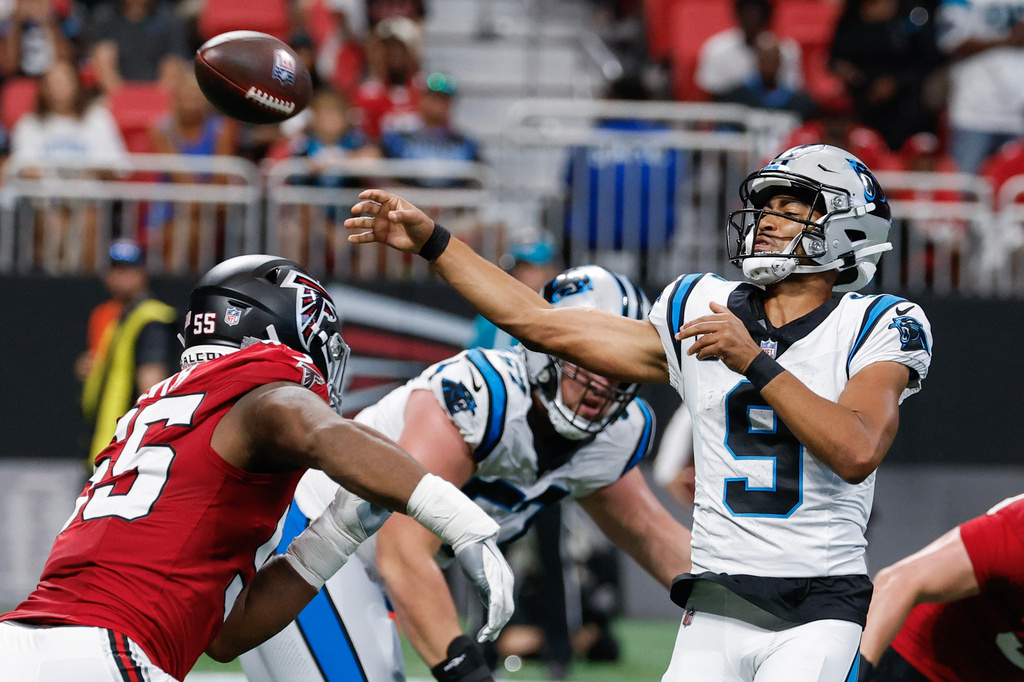
Carolina provides another example of successful adaptation. Bryce Young threw for 287 yards and three touchdowns in a 34-3 rout of Atlanta, helping the Panthers score at least 30 points in each of their first two games for the first time in franchise history. That does not make Carolina a finished product, but it suggests its offensive development deserves to be taken seriously.
The NFL’s opening fortnight has confirmed that talent sets expectations, but adaptability determines which teams survive injuries, poor starts, and the league's weekly volatility.
